By James M. Dorsey
As the US-Israel Iran war enters its eighth week, the prospect of a ceasefire in Islamabad hangs by a thread.
The prospect of negotiations in Islamabad is hanging in the balance. At this point, one fundamental problem beyond the seizure of the Tusker, the Iranian flag vessel by the U.S. Navy, one fundamental problem is that the approach to negotiations of both the United States and Iran is mutually exclusive. And essentially would involve concessions on one side that are unacceptable to the other side. In other words, what the United States wants is the Iranians to make concessions up front.
And then for the rewards, if you wish, issues like sanctions relief, lifting of the blockade, the U.S. blockade of the Strait of Hormuz to come once the Iranians have fulfilled their obligations. The Iranians on the other hand want concessions or agreements that are reached to be matched by the equivalent reward up front. And so the prospects for successful negotiation, even if they were to take place in Islamabad are dim.
In fact, with the seizure of the Iran flagged vessel, the prospects for a ceasefire coming out of potential talks are dim.
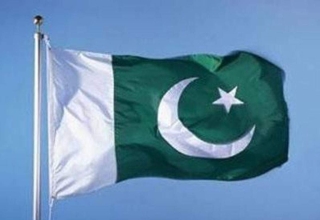
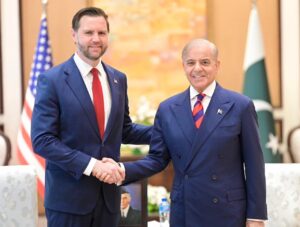
Anyhow, at this moment we don’t know that the ceasefire talks are going to take place. What we factually know is Trump says they will take place. U.S. advance teams have arrived in Islamabad and the Pakistanis are making the necessary security and other arrangements. Fact of the matter is that the U.S. negotiating team led by Vice President J.D. Vance has not left Washington. And at this point, even before the seizure of the Iranian vessel, the Iranians were saying that they were not going to attend the talks unless the U.S. blockade was lifted. So at this point, the talks themselves are uncertain.
But even if they do get to Islamabad, the prospects for an agreement of any kind are dim, given particularly the fact that Iranian retaliation for the seizure of the Iranian vessel is logical. And the U.S. response inevitably is going to be kinetic. In other words, they’re going to respond in kind.
That doesn’t create an environment that is conducive for negotiations, let alone for any progress.
The U.S., and if you just go through Trump’s true social media postings over the last 72 hours, for him a win is not just Iran accepting his conditions, but his ability to declare Iran has been defeated. The same is true for the Iranians. For them, a win is a lifting of the U.S. blockade, acceptance of a number of its conditions that it has set or goals that it has set for the negotiations, and its ability to declare a defeat of the United States.
Implying therefore, as long as you have an approach that does not aim to have a win-win situation in which both parties can declare victory and at the same time say that they have achieved their goals, you’re not going to come to an agreement. And part of the problem that we’ve seen over the weekend is that when Iran has made a gesture, Donald Trump has immediately moved to declare that gesture a surrender or a defeat of the Iranians. And, as a result of that, in response, Iran has hardened its position.